Wildfire Ash Testing in California: Lead, Arsenic, and Asbestos in Post-Fire Soil and When It’s Safe to Return Home.
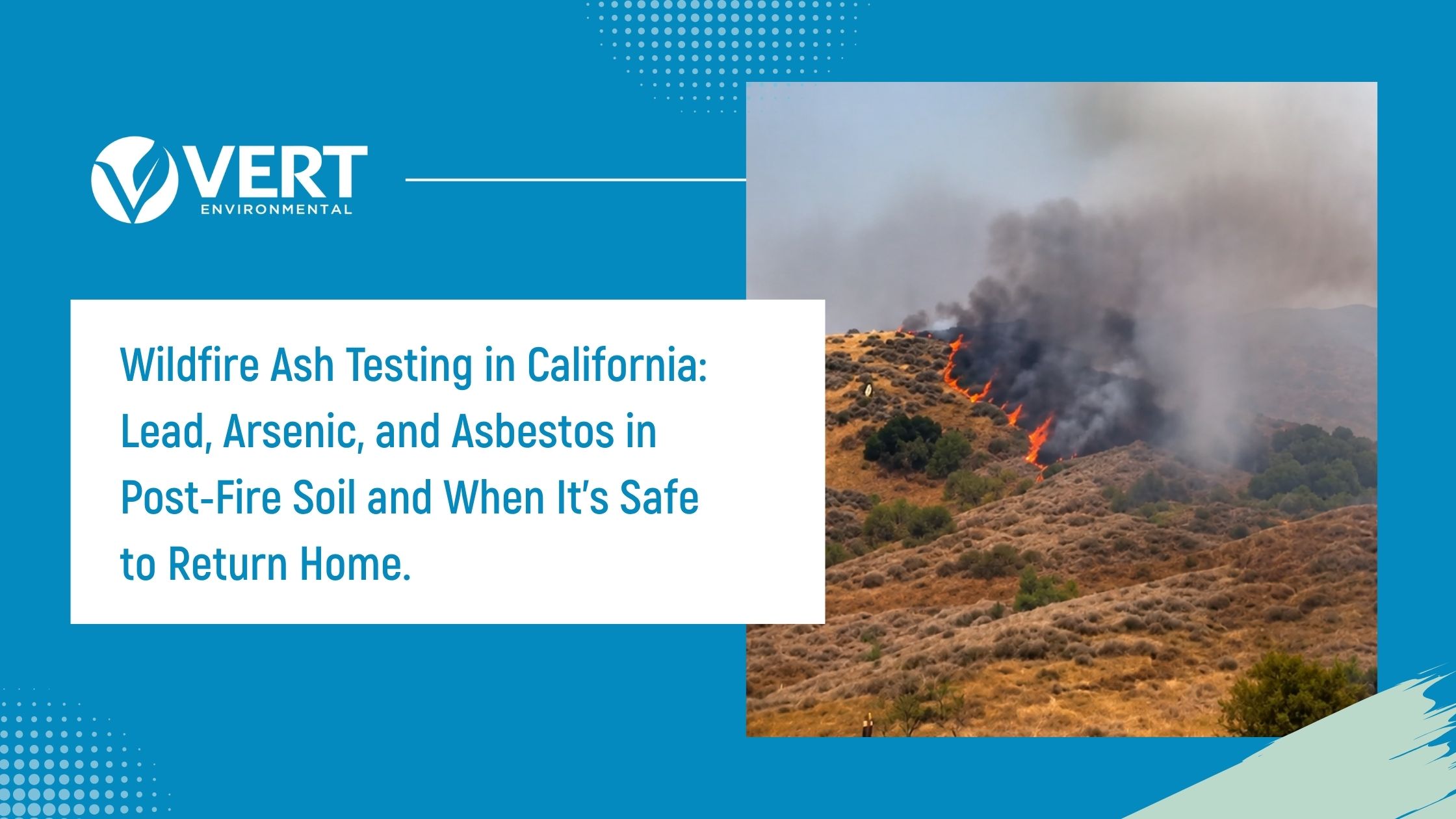
Sandy Fire and Bain Fire: What Southern California Residents Need to Know Right Now
Two major wildfires are burning across Southern California this week. The Sandy Fire ignited Monday morning off Sandy Avenue in Simi Valley and has scorched roughly 1,700 acres at 5% containment. Around 17,000 residents are under evacuation orders or warnings across Bell Canyon, Santa Susana Knolls, and eastern Simi Valley. The Bain Fire in Riverside County is forcing additional evacuations. 750 firefighters from Ventura County Fire, Cal Fire, and Morro Bay Fire are running a ground and air assault, including C-130 aircraft dropping retardant.
If you live in or near the burn zones, or downwind in Los Angeles, Riverside, San Bernardino, or Orange County, your property may carry hidden contamination long after the flames are out. Smoke and ash do not respect property lines. During the 2018 Camp Fire, toxic metals from burned structures were detected in smoke that traveled over 150 miles.
Here is what residents across Vert’s service areas should know before cleaning their property or returning home:
- Even unburned homes downwind of the Sandy Fire or Bain Fire can have hazardous ash settle on roofs, yards, vehicles, and HVAC systems.
- Visible ash on outdoor surfaces likely contains structural debris from burned homes, garages, and vehicles in the burn zone, not just vegetation.
- Sweeping, blowing, or hosing ash before testing can release lead, asbestos fibers, and fine particulates into your indoor air.
- Insurance carriers and adjusters often require documentation of independent third-party testing before approving cleanup and remediation claims.
- Children and pets are at the highest risk, since ash settles low and is easily tracked indoors on shoes and paws.
Vert provides same-day post-fire testing across Los Angeles, Riverside, San Bernardino, Orange County, San Diego, and the Bay Area. Our team can sample ash, surfaces, soil, and indoor air on the same day you call, with results in 24 hours. Schedule Smoke and Fire Residue Testing or Indoor Air Quality Testing now if your property has any visible ash or smoke residue.
Why Does a Property Look Calm After a Wildfire, Yet Still Hide Risks That Can Follow You Indoors?
That is the urgent reason wildfire ash testing in California matters. Ash is not always just burned trees. When homes, garages, vehicles, and building materials burn, the debris can carry lead, arsenic, asbestos, and other harmful byproducts. Before anyone sweeps, gardens, rebuilds, or moves back in, you need to know what is actually there.
That is where Vert Environmental can help. Vert provides wildfire ash testing in California by collecting ash, soil, dust, and surface samples from fire-affected properties and analyzing them for contaminants that may affect health, cleanup decisions, and safe re-entry. The goal is simple but critical: to give property owners clear answers, trusted documentation, and a safer path forward before they return home.
Here is what you need to know right away:
• Who needs it: Homeowners, property managers, insurance adjusters, and landlords with properties in or near California burn zones.
• What it detects: Heavy metals (lead, arsenic, cadmium), carcinogenic compounds (PAHs, dioxins), VOCs, asbestos fibers, and fine particulate matter (PM2.5).
• When to test: Before re-entry, before cleanup begins, and after remediation is complete.
• Who should perform it: Independent, California-certified environmental technicians with no conflict of interest in the remediation process.
As of May 2026, California’s wildfire seasons have grown increasingly more complex. The fires are no longer just burning timber; they are burning only timber. They are consuming entire neighborhoods, turning modern building materials into a toxic chemical soup. When a home burns, everything from the lead paint on the walls to the lithium-ion batteries in the garage is pulverized into microscopic dust. This dust, or particulate matter (PM2.5), isparticulate matter (PM2.5) is small enough to penetrate deep intoreach deep into your lungs and enter your bloodstream, significantly increasing the risk of heart attack or stroke
The Hidden Dangers of Wildfire Ash in California
Many of our clients in Southern California and the Bay Area initially believe that if their home didn’t burn, they are safe. Smoke and ash don’t respect property lines. During the 2018 Camp Fire, toxic metals like lead and zinc were detected in smoke that traveled over 150 miles. The January 2025 Palisades and Eaton fires saw high-velocity winds exceeding 100 mph redistribute contaminated topsoil across Los Angeles and Orange Counties. The Sandy Fire and Bain Fire burning right now are following the same pattern, making post-fire testing a necessity for unburned structures as well as those in the direct burn zone.
The danger lies in what the eye cannot see. White ash from trees is relatively low-toxicity, though still a respiratory irritant. Black ash and char from structural fires are a different problem entirely. It contains a mix of heavy metals, Polycyclic Aromatic Hydrocarbons (PAHs), and Volatile Organic Compounds (VOCs).
| Contaminant | Source | Health Risk |
|---|---|---|
| Lead | Pre-1978 paint, electronics | Neurological damage, especially in children |
| Arsenic | Treated lumber (CCA), natural soil | Carcinogen, skin, and lung irritation |
| Asbestos | Older insulation, flooring, and roofing | Mesothelioma, lung cancer |
| PAHs | Incomplete combustion of plastics | Long-term cancer risk |
| PM2.5 | Microscopic soot particles | Respiratory failure, heart attack |
Chemical Composition and Health Risks of Wildfire Ash
Scientific research, including the collection of ash and burned soils from the October 2007 Southern California wildfires, has shown that the chemical composition of ash varies widely depending on what was burned. When we perform post-wildfire air quality testing, we aren’t just looking for “soot.” We are not looking for soot alone. We are looking for toxic markers.
Heavy metals like cadmium and mercury can persist in the soil for decades. Even more concerning are carcinogenic compounds like benzo[a]pyrene, which form during the burning of household plastics. These toxins don’t just sit on the ground; they sit on the ground. They can be resuspended by the wind or tracked into your home on shoes and pet paws, creating a long-term exposure risk for your family.
Structural vs. Vegetative Ash: Why Source Matters
Distinguishing between “forest ash” and “house ash” is a critical part of our diagnostic process. Vegetative ash is primarily composed of calcium, magnesium, and potassium. While it can cause chemical burns if it gets wet and comes into contact with your skin, it lacks the heavy-metal load of structural ash.
Structural ash is more hazardous than ash from trees or brush because it can contain chemicals from burned homes, garages, vehicles, and household products. After a wildfire, ash and dust may include lead, arsenic, asbestos, and other toxic materials that should not be inhaled or tracked indoors. The EPA advises people to avoid disturbing ash, keep children and pets away, and use proper protection during cleanup.
If you are returning to a property built before 1978, lead-based paint in fire debris is an especially important concern. Our Lead Testing service uses Viken XRF analyzers to detect lead in dust, soil, and surfaces in real time.
Environmental Impact on Soil and Water Quality
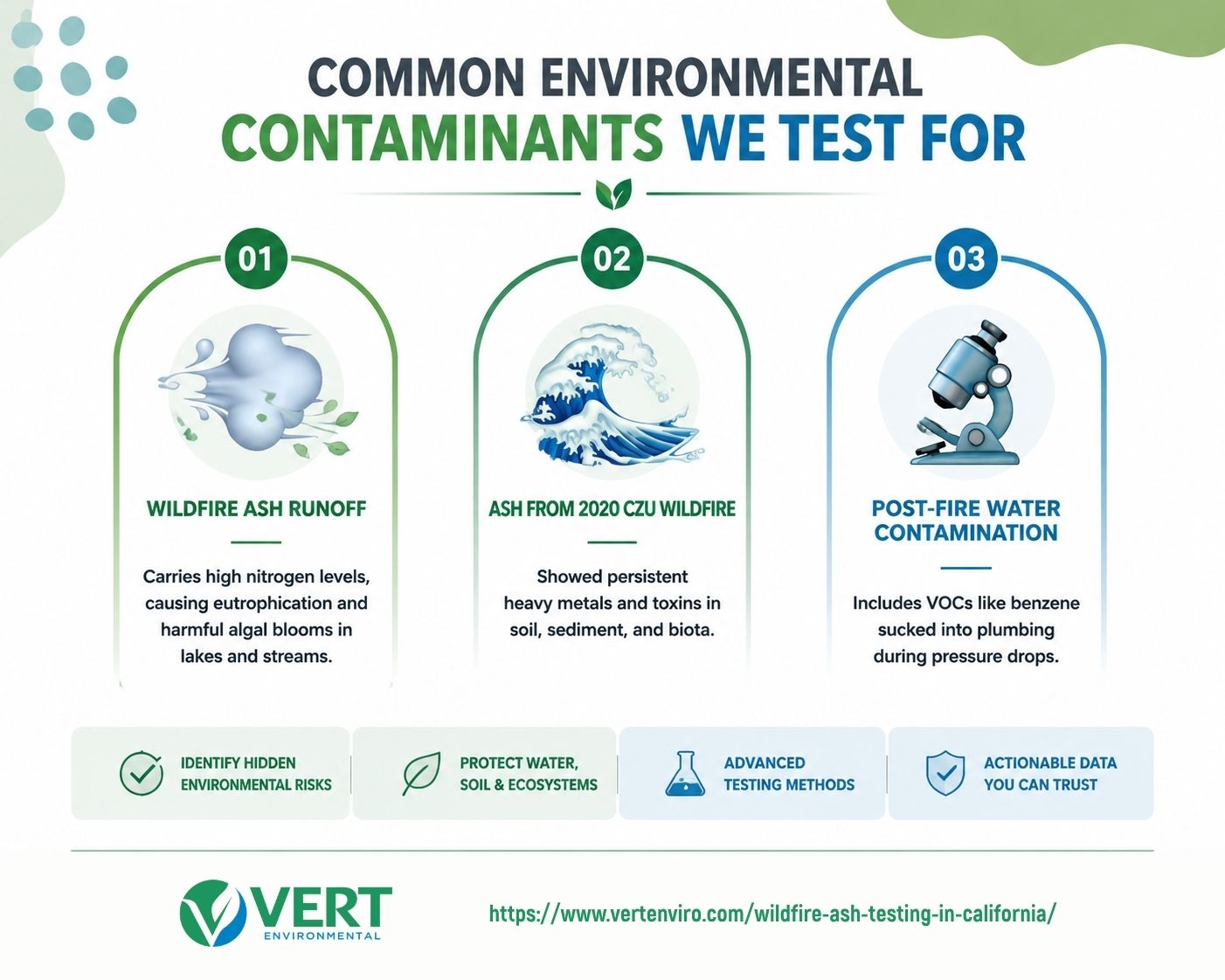
The impact of a wildfire reaches far beyond the air. Research on the compositions of ash and soil after the 2020 CZU Lightning Complex Wildfire shows how ash runoff can devastate local watersheds. High levels of nitrogen in ash can lead to eutrophication in lakes and streams, fueling harmful algal blooms that choke out aquatic life.
Furthermore, wildfires also have a profound direct impact on water quality. When water pressure drops during a fire, benzene and other VOCs can be sucked into the plumbing system. Boiling this water actually makes it more dangerous, since it vaporizes the chemicals into the air you breathe. This is why we recommend comprehensive testing for any property within a burn scar, covering everything from the soil in your yard to the water in your taps. Soil Testing for the yard and Water Testing for the taps.
Professional Protocols and Safe Recovery in California
When it comes to your health, “DIY” For something as health-critical as post-fire contamination, DIY is not an option. Professional wildfire ash testing for California residents requires specialized equipment and strict adherence to EPA and OSHA standards. We utilize the Viken XRF lead gun, the industry gold standard for detecting lead and other heavy metals in real- time. This allows us to provide immediate data on whether the dust in your home contains hazardous levels of lead from burned paint or infrastructure.
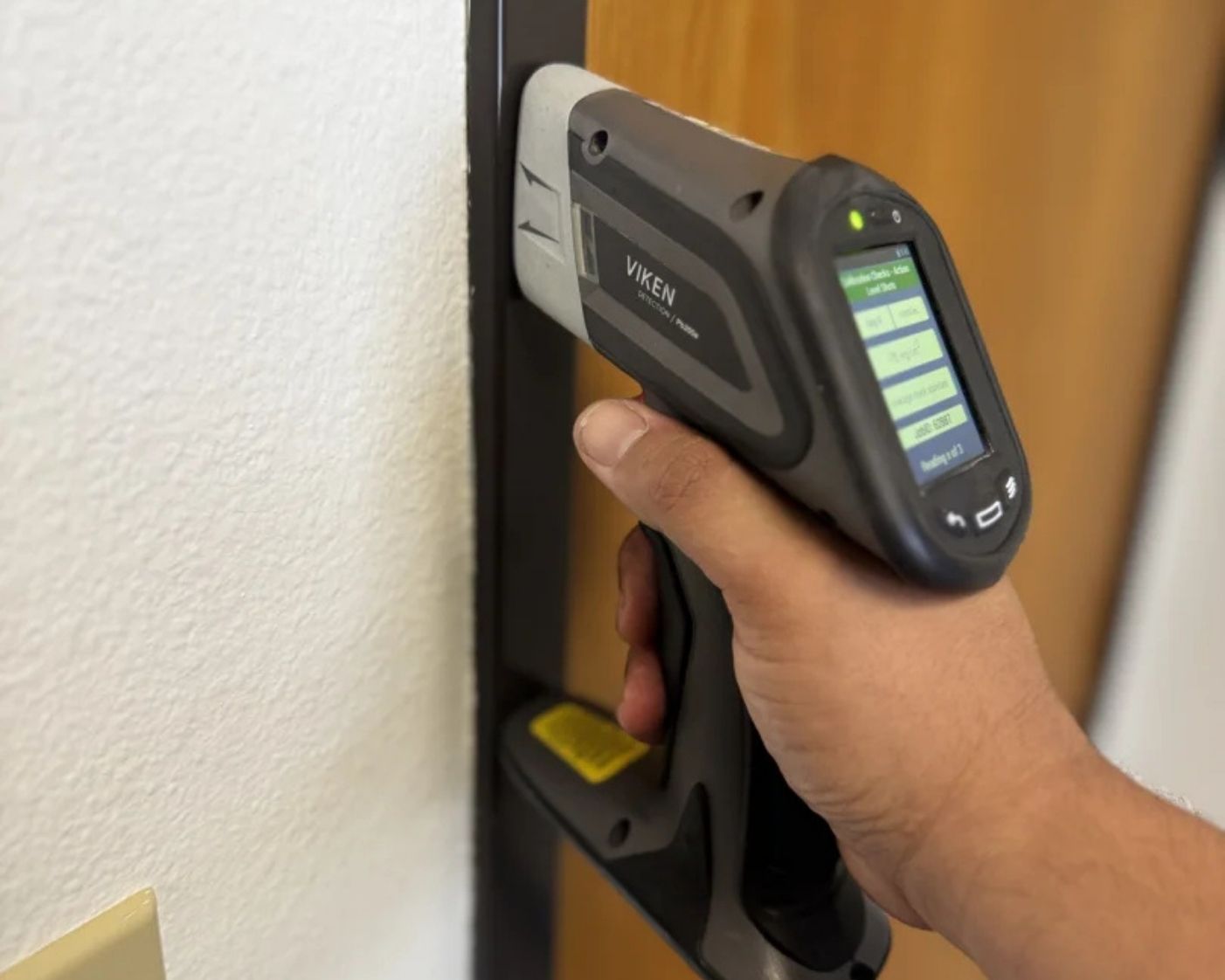
When it comes to your health, “DIY” For something as health-critical as post-fire contamination, DIY is not an option. Professional wildfire ash testing for California residents requires specialized equipment and strict adherence to EPA and OSHA standards. We utilize the Viken XRF lead gun, the industry gold standard for detecting lead and other heavy metals in real- time. This allows us to provide immediate data on whether the dust in your home contains hazardous levels of lead from burned paint or infrastructure.
Standard Laboratory Techniques for Wildfire Ash Testing in California
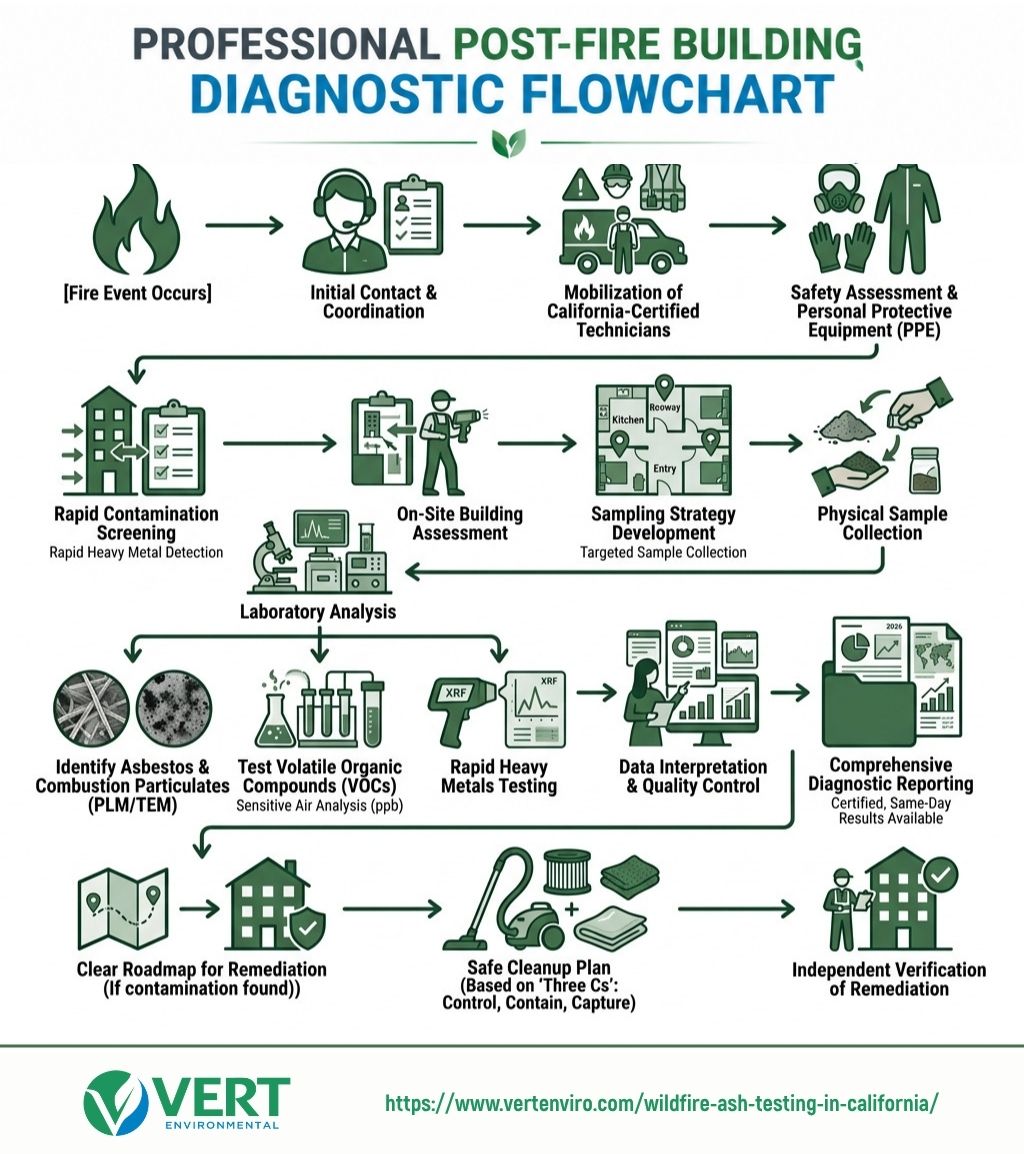
Our smoke and fire damage testing protocols involve several layers of analysis:
- PLM (Polarized Light Microscopy): Used to identify asbestos fibers and combustion particulates like char and soot.
- TEM (Transmission Electron Microscopy): A more sensitive method for detecting microscopic asbestos fibers that PLM may miss.
- TO-15: The standard EPA method for testing Volatile Organic Compounds (VOCs) in the air, sensitive down to 0.01 parts per billion.
- Viken XRF Lead Analyzer: For rapid, non-destructive testing of surfaces and soil for heavy metals.
For a standard 1,500-square-foot home, we collect about 7 sets of samples. This ensures we have a representative map of contamination, focusing on high-traffic areas such as kitchens and bedrooms, as well as entry points where ash is most likely to accumulate.
The Vert Operating System (VOS): Accuracy and Trust You Can Verify
How does the Vert Operating System (VOS) turn a chaotic wildfire response into a precision-guided recovery? Think of VOS as our internal “rulebook” that ensures every single service request is handled with the same high level of accuracy and care.
When you call us, you’ll speak with one of our expert Project Coordinators. These professionals are chosen for their deep experience in the environmental industry rather than just a degree. They exclusively handle the complex logistics of scheduling and coordination, ensuring our California-certified technicians arrive on-site with exactly what they need. Because our coordinators do not go on-site, they can focus entirely on being your guide through the process, providing “education-led trust” from the first phone call to the final report. VOS ensures that your data is handled securely and your results are delivered with the same-day speed that California emergencies require.
Safe Cleanup and the Three Cs of Ash Management
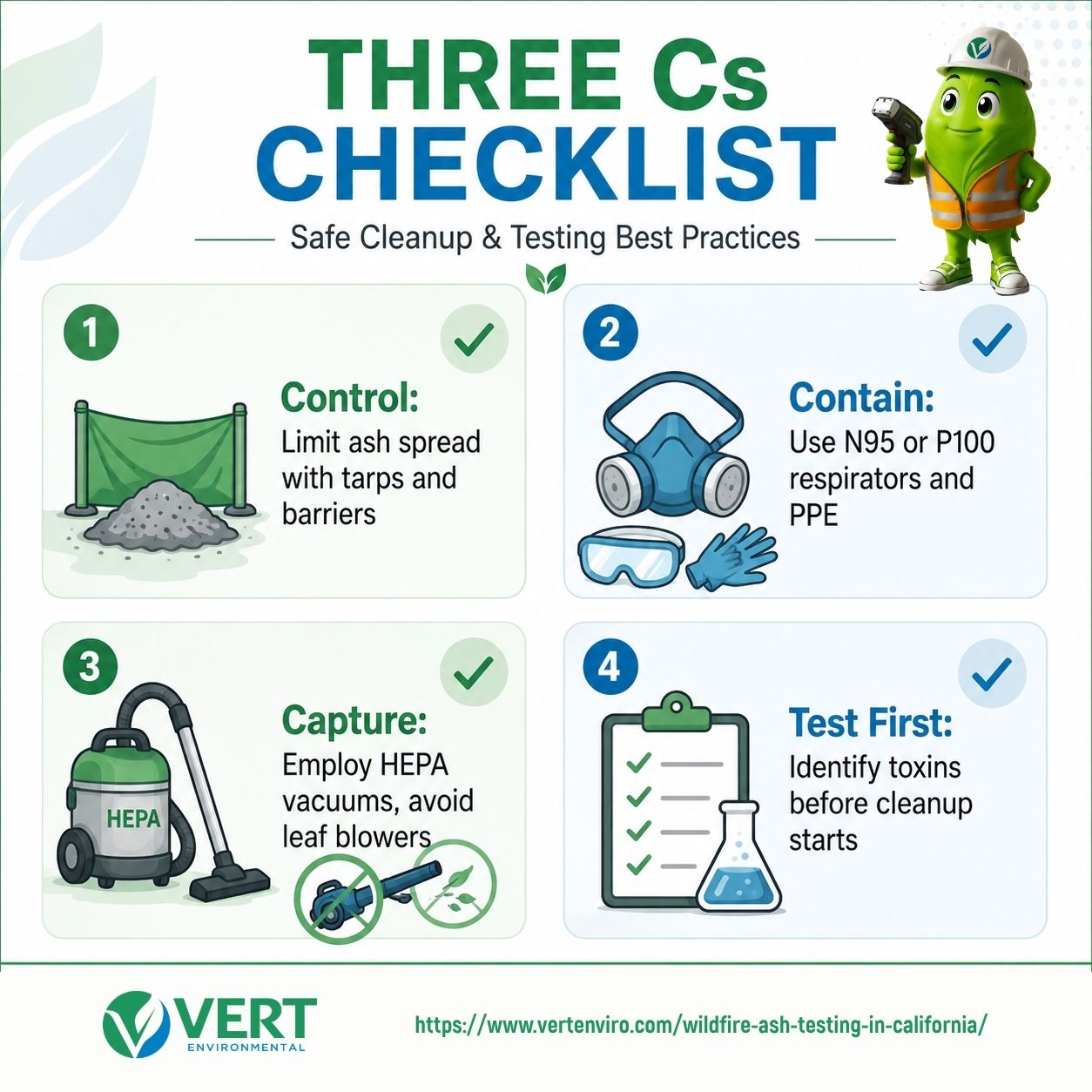
If our testing reveals contamination, the cleanup must follow the “Three Cs”: Three Cs:
- Control: Prevent ash from becoming airborne. Never use leaf blowers, brooms, or garden hoses on dry ash.
- Contain: Use plastic sheeting and HEPA-filter vacuums (not standard shop-vacs) to trap particles.
- Capture: Use wet-mopping and damp cloths to physically remove the residue.
We strongly advise checking what testing options are available before you start scrubbing. Cleaning without a plan can often make the problem worse by stirring up settled toxins. Our essential environmental testing for fire-damaged properties gives you a clear roadmap for remediation.
As an independent third-party testing firm, Vert Environmental has no conflict of interest. We don’t perform the cleanup; we only provide. We provide the honest, certified data you need to ensure that the job was done right. With over 12 years of experience and locations across San Diego, Orange County, Los Angeles, the Quad-County region, and the Bay Area, we are here to help you move forward safely.
Schedule Post-Fire Testing in Southern California or the Bay Area
The Sandy Fire, Bain Fire, and other active California wildfires are creating contamination zones that reach far beyond the visible burn perimeter. If you live downwind, see ash on your property, or are preparing to return home after an evacuation, professional testing replaces guesswork with clear data.
Vert Environmental offers same-day post-fire testing across our service areas. Our most-requested services for fire-affected properties:
• Smoke and Fire Residue Testing: Full assessment of ash, char, and soot contamination on surfaces, in soil, and in indoor air.
• Indoor Air Quality Testing: PM2.5, VOC, and combustion byproduct screening for homes downwind of active fires.
• Lead Testing: Viken XRF analysis for lead contamination from burned pre-1978 paint and infrastructure.
• Asbestos Testing: PLM and TEM analysis for asbestos fibers released from burned older insulation, flooring, and roofing.
• Soil Testing: Heavy metals, PAH, and hydrocarbon screening for yards, gardens, and play areas.
• Water Testing: VOC, benzene, and bacterial screening for homes where water pressure was lost during the fire.
Call Vert Environmental today to schedule independent post-fire testing. Protect your family, your home, and your peace of mind before the cleanup crew arrives.

Related Articles

Legionella Testing for Cooling Towers: Why Commercial Properties Need Proactive Testing
Asbestos Clearance Testing: What Insurance Adjusters and Restoration Contractors Need